

What Are Three Mechanisms That Cells Use To Repair Thymine Dimers.
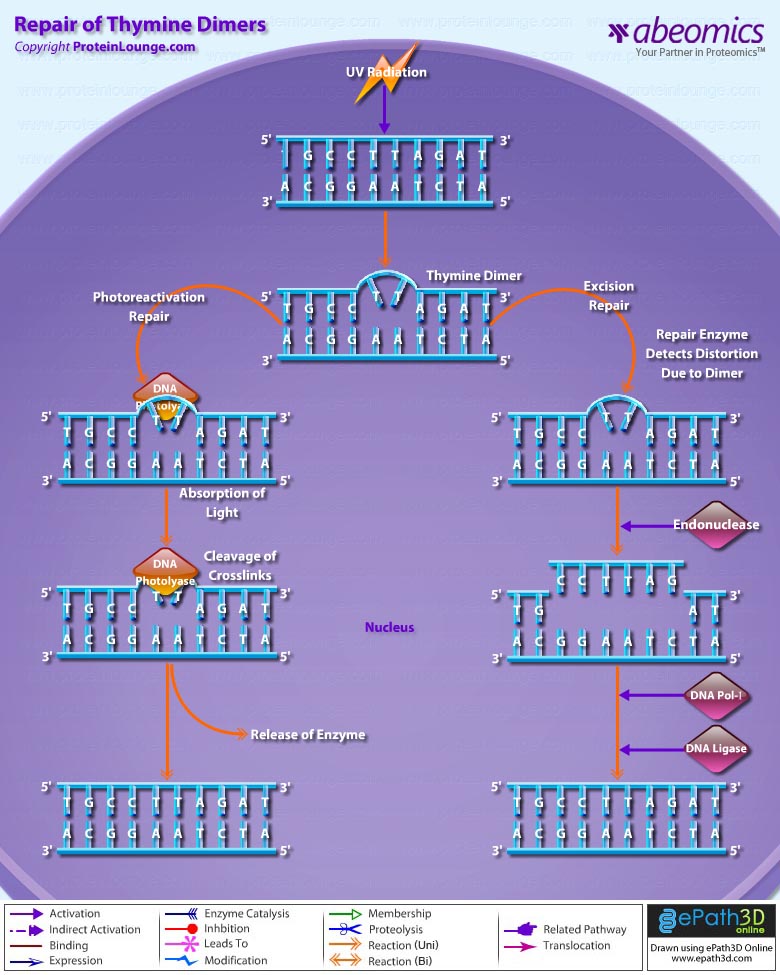
Irradiation of DNA by UV (ultraviolet light) causes lesions, such equally cyclobutane-pyrimidine dimers or 6-4PPs (6-4 pyrimidine pyrimidone). The nearly common covalently linked bordering pyrimidines are T-T (thymine dimers), T-C (thymine-cytosine dimers) and C-C (cytosine-cytosine dimers). T-T dimers cause kinks in the DNA strand that prevent both replication and transcription of that part of the Deoxyribonucleic acid. Because they block Dna replication (and therefore prevent cells from reproducing), T-T dimers and other forms of UV damage cannot be inherited, and thus practise not establish mutations. Such kinds of Dna damage are known as premutational lesions because they prevent both transcription and replication of the genes in which they are present, and these lesions are fatal if they go uncorrected (Ref. 2).
Several mechanisms are available for the removal or correction of T-T dimers from DNA depending upon the circumstances of the cell. Certain organisms posses a photoreactivating enzyme called photolyase, which contains chromophores capable of capturing photons of blue light (of wavelength 350-450 nm). Photolyase first detects and binds to the damaged DNA site (a pyrimidine dimer). And so it uses light free energy absorbed from the visible range (lambda = 370 nm) to oxidize the cyclobutane ring and catechumen the dimer into monomers without disrupting the double strands. Finally, the enzyme dissociates from the Deoxyribonucleic acid and the damage is repaired. Recognition of cyclobutane-pyrimidine dimers past photolyase is structure specific and the enzyme is non influenced past the nucleotide content surrounding the dimer. Photoreactivation, however, is affected by the nucleotide content of the pyrimidine dimers. The cyclobutane-pyrimidine dimers photolyase is establish in prokaryotes, lower and higher eukaryotes, only their existence in placental mammals is still unknown (Ref.1). Hence, the repair of T-T dimers in humans takes place through an excision repair mechanism. This repair mechanism does not require light and instead of just breaking the bonds of the T-T dimer as was done by photolyase, it excises the region of damaged nucleotides. A poly peptide complex recognizes the distortion in the DNA caused by the T-T dimers and a pair of endonucleases makes nicks in the Dna strand on either side of the T-T dimer. By and large, the nicks are 12 nucleotides apart and the Deoxyribonucleic acid between the nicks is removed. Deoxyribonucleic acid polymerase I fills in the gaps left behind, and Dna ligase seals the final nick in the Deoxyribonucleic acid. In addition, other mechanisms such equally mutagenic repair or dimer bypass, recombinational repair, jail cell-wheel checkpoints, apoptosis, and sure culling repair pathways are also operative in various organisms for the removal or correction of T-T dimers (Ref. 2).
The UV component of sunlight is responsible for the consecration of skin tumors, most notably basal prison cell and squamous cell carcinomas and melanomas (Ref. 3). The presence of UV induced dimers in the DNA is damaging, and it may cause a mispairing every bit the strand is being copied or may end replication altogether. Unless repaired, pyrimidine dimers may pb to blockage of transcription, mutations, cell death and cancer (Ref. 4).
References:
1.Photorepair prevents ultraviolet-induced apoptosis in human cells expressing the marsupial photolyase gene.
Chigancas V, Miyaji EN, Muotri AR, de Fatima Jacysyn J, Amarante-Mendes GP, Yasui A, Menck CF.
Cancer Res. 2000 May 1; threescore(ix): 2458-63.
2.UV-induced Deoxyribonucleic acid damage and repair: a review.
Sinha RP, Hader DP.
Photochem Photobiol Sci. 2002 Apr; 1(4): 225-36. Review.
3.Photoreactivation of UV-induced cyclobutane pyrimidine dimmers in the MFA2 factor of Saccharomyces cerevisiae.
Morse NR, Meniel V, Waters R.
Nucleic Acids Res. 2002 Apr 15; 30(8): 1799-807.
4.Chromatin construction modulates DNA repair by photolyase in vivo.
Suter B, Livingstone-Zatchej Thou, Thoma F.
EMBO J. 1997 Apr 15; 16(8): 2150-60.

What Are Three Mechanisms That Cells Use To Repair Thymine Dimers.,
Source: https://www.abeomics.com/repair-of-thymine-dimers
Posted by: gowenwhel1976.blogspot.com
0 Response to "What Are Three Mechanisms That Cells Use To Repair Thymine Dimers."
Post a Comment